
The emotional state of a stock trader can have a decisive influence on financial results. One of the most common and insidious psychological problems is the FOMO syndrome. Many people suffer huge losses due to its effects. What is this affliction and how to act when it appears in daily trading? We will tell you below. Being informed means being armed, and this rule applies to minimizing the consequences of FOMO, one of the most cunning psychological disorders.
What causes the problem
FOMO in trading can occur in a trader, especially a beginner, as often as the opportunity to make a profit. The abbreviation stands for “fear of missing out” — “fear of missing an important event” (literally) or “fear of missing out on gains.” The term appeared relatively recently in the cryptocurrency market. Specifically, in crypto trading, many interesting additions come into trading slang. Previously, traders had an idea about them but hesitated to define a specific term for this recurring phenomenon. Just as technical analysis has its own patterns in trend formation, human psychology can be traced through certain behavioral models. The better a person understands their character and motives, the more tools they have to work without emotions, leading to additional profit.
The problem most often manifests in novice traders due to inexperience.
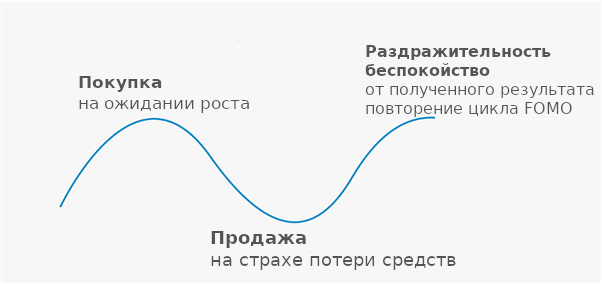
A quick analysis of the image shows that the main prerequisite for FOMO is incorrect analysis and choosing an inappropriate entry point. This is typical for beginners.
The problem is more psychological than analytical. With a reliable trading system, you can eliminate a losing order at the very beginning of a movement against the trade. Psychology, in this case, prevents distinguishing your account from drawdowns.
FOMO can manifest in a personal attitude towards oneself. For example, after an unsuccessful position close, a trader analyzes the chart and retrospectively sees a missed opportunity. Another manifestation is the feeling that others are more successful. To appear successful, many hide their losses and pretend to be more talented. Beginners will strive for equally profitable trading, which due to inexperience leads to mistakes and losses.
Emotionally, FOMO can be expressed as:
- greed
- excitement
- fear
- envy
- anxiety
None of these emotions will lead to long-term profit. It is important to limit their manifestation as much as possible.
FOMO-prone traders tend to follow similar behavior patterns, grouped by specialists into the following list:
- “Everyone is doing it, it won’t be bad.” Blindly following the crowd can lead to significant losses. Careful analysis and serious reasons are needed to open an order.
- “I can make so much money!” Trading based on unfounded profit expectations rarely yields profit. No one knows when even the strongest trend will end. Therefore, it’s essential to know the best entry point and compare it with the current situation. Also, have protective strategies to prevent losses.
- “Maybe I should try this trade.” Such unfounded indecision should not be a reason to open an order.
- “I should have known this would happen.” Self-blame after a loss indicates the absence of a working trading strategy to prevent drawdowns.
- “They know what I don’t.” Perhaps, but such insider information cannot last forever. If a movement occurred without a clear reason, it will soon be confirmed by news or economic indicators, or it signals that a large position is being closed.
- “I’m afraid of missing a big opportunity.” This is a direct consequence of not having a working trading strategy. An experienced trader with clear rules for opening, holding, hedging, and closing orders knows when to take specific actions on open orders.
- “The Japanese yen (pound, euro, dollar, Bitcoin, Litecoin, etc.) is a quite safe asset, I will invest in it.” This statement is true by itself but does not indicate the best moment to open a position.
Register on a trusted exchange ByBit
Main reasons for FOMO manifestation

Although FOMO in trading is purely psychological, it is most often caused by the following market situations:
- High volatility. A trader may place too much hope, but the situation on such platforms can change too quickly, preventing sufficient profit due to excessive emotions.
- “Lucky streaks.” Several large profitable trades closed in a row can cloud judgment, leading to reckless trading “just for opening an order,” without a serious reason to enter the market. This inevitably results in a series of losses, which can trigger FOMO, tying the hands and preventing proper work in financial markets.
- “Loss series.” If a series of profitable trades is followed by deceptive euphoria, then a series of closed losing orders reduces confidence in oneself, causing doubt in a well-thought-out decision. This is FOMO.
- Rumors. Information about huge profits of market participants can undermine self-confidence. This manifests as the previously mentioned uncertainty.
- Overtrust in social networks. Often, only highly profitable trades are showcased, while losses are hidden. Trust in such “mega-players” can develop insecurity about one’s own abilities. It’s important to remember that the probability of profit when opening a trade is 50%. The only difference is how risk management is handled.
Sometimes, FOMO can lead to large market movements, but in any case, there must be an informational basis.
Disciplined trader versus FOMO player

Comparing the qualities of a disciplined trader and a FOMO player, the following traits stand out:
- A trader with a working strategy follows a clear plan, trades on news. A FOMO player relies only on their opinion, rumors, without verifying them.
- A disciplined player uses a risk management system comfortable for them. A FOMO syndrome trader will constantly adjust stop-limit orders, with characteristic adjustment in an unfavorable direction.
- A professional trader follows their trading strategy, records all market positions, and pays special attention to analyzing losses. FOMO forces a trader to follow only emotions.
How to avoid the syndrome
Everyone should understand — no one is immune to emotions in investments. Of course, this causes more problems for the inexperienced. Professionals recommend following these tips:
- You can open another trade. No matter what emotional state FOMO leaves you in, the market always offers excellent opportunities. The main thing is to approach it prepared.
- Emotionally, everyone is equal on the market. Regardless of experience, account size, and individual capabilities, everyone can encounter FOMO. If you treat it as a routine matter, the problem will soon cease to have a significant impact on results.
- Following a clear trading strategy can offset any emotional manifestation. Therefore, in cryptocurrency trading, as in any financial sphere, it is important to have and adhere to clear trading rules. They should include rules for opening, holding, risk management, and closing orders.
One of the main postulates of a well-structured trading strategy is to invest in each trade an amount of capital that, if lost, will not cause strong negative emotions, and thus will not trigger FOMO syndrome.
Overcoming the problem cannot happen overnight; it takes time. And if you know what techniques to apply to prevent negative consequences of such emotions, anyone can bring their trading to a profitable level.