

As the number of cryptocurrency traders increases, a need has emerged, similar to stock trading, for assets that can hedge or minimize risk. In cryptocurrency, regardless of the specific asset, the trend is extremely volatile and even more unpredictable. Therefore, having the opportunity to hedge risks is a trader’s dream. Next, we will explore stablecoins: what they are, whether they can insure against risks, or if it’s just another trick for beginners in crypto trading.

What is a stablecoin and how to use it wisely?
A stablecoin is a special type of digital asset designed to reduce volatility influence during crypto trading. It’s hard to find a trading instrument more volatile than cryptocurrency. You can get fabulously rich in a short time or go bankrupt hopelessly. To increase the chances of making a profit, even at the expense of trading time, stablecoins were invented. The term translates from English as “stable coins.”
In Russia, few people know about them, so the following information will be presented in simple words so that even a beginner crypto trader can understand this issue.
The first noticeable difference is the strict pegging of stablecoins to the most stable world currencies. Compared to unsecured cryptocurrencies, stablecoins can be used as a trading asset in daily operations. However, due to their low volatility, which is primarily linked to the underlying asset, they are most often used as a hedge.
The most famous stablecoin in the world
The most well-known and consequently the most widely used stablecoin is Tether. Its exchange ticker is USDT, indicating that the base currency is the US dollar.

The trading scheme relies on the issuer of the currency having the obligation to hold a proportionate reserve of US dollar equivalents in a special bank account. Therefore, the amount of USDT and the fiat (not backed by metal or gold reserves) dollars are always equal.
To acquire Tether, access is needed to the following exchanges:
- Binance (a large international exchange with Chinese roots)
- Exmo (the largest cryptocurrency platform in Eastern Europe)
What types of stablecoins exist?
Besides the briefly discussed Tether, there are other stablecoins that traders should pay attention to. Not only because they significantly reduce the risk level in currency trading, but also because they are not yet fully appreciated by traders, which means their potential is high both as a hedge and as a source of income.

Stablecoins can be based not only on major world currencies but also on other cryptocurrencies. For example, Maker DAO offers some of the best trading conditions. It is based on the ERC-20 standard (Ethereum’s basis). It’s a very successful combination of a simple crypto stock.

Do not overlook Basecoin, created, promoted, and supported by a host of major venture funds including Andreessen Horowitz, Digital Currency Group, and others. Its rate is constantly adjusted based on the value of the underlying asset — the US dollar.
It’s also worth mentioning that regulation of stablecoins is carried out not only by their creators and interested companies but also through smart contracts. The entire idea of such currencies’ functioning, regardless of their fundamental tools and affiliated entities, relies on strict adherence to mathematical principles that embody the idea of a “stable coin.”
Instruments based on the US dollar are very popular among individual investors. After earning profit from basic cryptocurrency trading, they invest in stablecoins to lock in gains and ensure reliable protection by purchasing secured assets.
When it comes to “coins” backed by cryptocurrencies, traders tend to be more risk-oriented. However, such investments are usually made over longer-term periods.
Crypto instruments without any backing—whether material or crypto—are of interest mainly to venture funds, which are willing to invest resources into assets with medium-term growth potential.
Differences between cryptocurrency and stablecoin
The main and most significant difference between a stablecoin and a cryptocurrency (in stock market slang — “crypto” vs. “stable”) is the markedly different levels of volatility. Cryptos are characterized by very high variability, with prices changing by dozens or even hundreds of percent within a single day. For stablecoins, the goal is to provide market participants with a “safe haven.” This is especially important when the strategy involves not the highest income but stable and predictable risk levels.
An important fact is that the issuer of a stablecoin has the ability to produce unlimited issuance (within the guarantees of the underlying asset, of course). Unlike cryptocurrencies, whose supply is known in advance, additional emissions can help smooth out fluctuations even in the most unstable markets.
The main advantages of stablecoins include:
- Low volatility (course fluctuations over time)
- Backing by real assets
- Can be used independently as a reliable way to invest and grow funds
- No external regulators (such as government agencies or companies, or issuers)
It is also important to consider the disadvantages of “stablecoins.” These include:
- The possibility of the issuer (company or group) influencing the volume of the circulating asset, which can affect the exchange rate.
- Problems with some stablecoins (most often Tether), which undermine investor trust in the entire asset group.
- The risks of losing backing assets (for example, cyberattacks on specific bank accounts where fiat funds of a particular stablecoin are stored), which could lead to the complete devaluation of the asset.
Which stablecoins to choose
By the end of 2019 — early 2020, the most recognized stablecoins were:
- TUSD (True USD) — a relatively young (introduced in 2018) stablecoin backed by the US dollar at a 1:1 ratio


- USDT (Tether) — the most famous stablecoin on the market. With the emergence of new assets, it is somewhat losing its popularity but still remains a leader.
- USDC — developed jointly by the cryptocurrency exchange Circle and Coinbase. Due to its lower popularity, it has great growth potential as an independent asset.
- GUSD — another project by a cryptocurrency exchange, this time Gemini.
- DAI — a currency based on the idea of decentralization. According to developers, it helps protect investors from unexpected fluctuations and even crashes in other markets.


Of course, the full list of stablecoins is much broader, and any interested trader can easily add any to their portfolio. However, the above-mentioned have already proven how to build a well-known name thanks to reliability and offered opportunities. They can thus be used as hedging assets without restrictions.
In conclusion
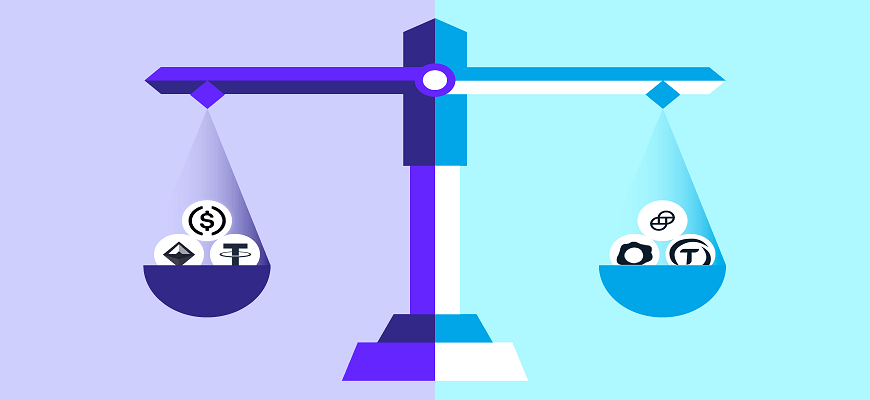
After discussing what stablecoins are, how to work with this instrument, and which assets to pay the most attention to, it’s impossible not to note that this tool is definitely worth the attention of a broad range of market participants. Ordinary traders can earn a small but guaranteed income using this instrument. Cryptocurrency traders can smooth out short-term negative fluctuations of the main currency’s rate. Investors will find ways to preserve and increase their assets (with promising instruments — in the shortest possible time).